Craig’s notes
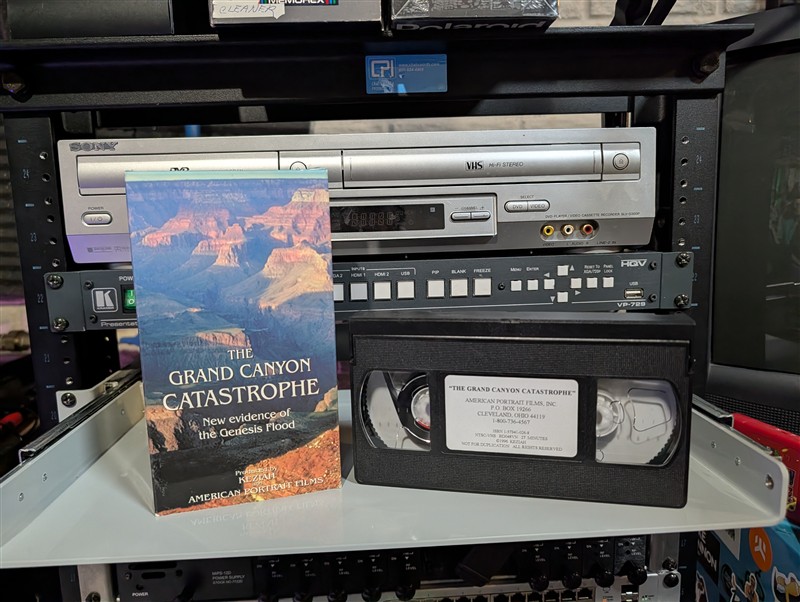
The Grand Canyon Catastrophe promised four doctors and new evidence for the Genesis Flood. The sleeve introduced four doctors: three credited to the Institute for Creation Research and Andrew Snelling to the Creation Science Foundation. I joked that they were handing out doctor's degrees to everybody; seeing all four tied to creationist organizations made those titles feel like part of the sales pitch. Before we even started, I got stuck on the packaging's About Time series name. For a video arguing that the Earth is only a few thousand years old, that's a pretty good name. Then the opening brought in Havasupai flood accounts to support a biblical argument, which made me wonder why those accounts had been drafted for this particular job.
The film went to Yellowstone, stood at the Grand Canyon, then brought in Mount St. Helens and the Grand Coulee to make its case. Its answer kept coming back to a lot of water in a short time. Somewhere in the middle I got distracted by a discussion of tucked shirts and whether I could get away with wearing JNCO jeans again. But I was listening when the film argued that there wasn't enough sediment at the Colorado River's mouth for the river to have carved the canyon. Wouldn't its own giant rush of water have to put that sediment somewhere too? I wanted that explained.
Then the film ended. I thought we were about to get more, so the actual catastrophe was how soon the tape stopped. The doctors had given us a lot of water, but I still had a question about where it all went.
Content inventory
Shows and segments (playback order)
- The Grand Canyon Catastrophe: opening and Havasupai flood accounts: The film invokes Havasupai accounts of floodwaters while presenting its Genesis Flood argument; these are the film's claims, not a validation of its geology or of that use of Indigenous tradition.
- Yellowstone: Dr. Steve Austin and rapid canyon erosion: The film discusses the Grand Canyon of the Yellowstone and proposes rapid erosion.
- Grand Canyon: Dr. Andrew Snelling and ancient-lake drainage: Snelling argues that an ancient lake breach could have cut the canyon rapidly.
- Mount St. Helens mudflows: The documentary compares rapidly cut channels after the 1980 eruption with its Grand Canyon theory; the comparison does not establish the canyon's age.
- Proposed ancient lakes and Hopi Lake: Maps of hypothetical lakes precede a discussion of geologist Eugene Shoemaker, who is described as favoring gradual drainage for Hopi Lake.
- Grand Coulee and eastern Washington flood evidence: The film cites eastern Washington flood channels to argue for rapid cutting elsewhere.
- Colorado River sediment question: The film asks where river-carried sediment went. Craig asks whether its proposed larger flood would face the same question.
- Genesis Flood conclusion and unexpectedly short ending: The film returns to a recent global flood and ancient-lake drainage; Craig asks where the water went and is surprised when the tape ends.
Tape details
- Archive ID
- VHS-2025-054
- Recording type
- Commercial release
- Format
- VHS
- Release year
- 1996 (contemporaneous listing; Craig read ©1996 from the sleeve)
- Viewed
- April 5, 2026
- Recording date
- Not applicable to this commercial release
On the label
- Front sleeve: The Grand Canyon Catastrophe / New Evidence of the Genesis Flood: American Portrait Films is printed on the sleeve; the tape's printed label repeats the title.
- Back sleeve: breached-dam theory and four featured speakers: The sleeve credits John Morris, Duane Gish, Steve Austin and Andrew Snelling. These are the video's advocates and the theory is attributed to the film.